Ghosted? What to Do Next - SLIDD AI
Ghosted What to Do Next (And What to Say If You Try Again)
Ghosted what to do is the search every guy ends up running the morning after realizing she's not coming back to the conversation. The short version: stop reaching out for two to four weeks, then send one non-accusatory message tied to something specific from your last real conversation — not a "where did you go?" text. Most of the top advice on this topic tells you to never reach out again, full stop — that blanket rule ignores the cases where a specific, well-timed message actually reopens things.
Ghosted What to Do First: What It Actually Means
Ghosting means the other person stopped responding entirely, with no explanation, and no plan to give you one. It's different from being left on read once or twice — that's a delay. Ghosting is a pattern: silence that holds for days, then weeks, with zero signal that a reply is coming.
If you've watched a conversation stall out in real time, what it means when she stopped replying covers the early-stage version of this — the moment before silence hardens into a full ghost.
It rarely means what it feels like it means. The instinct is to run your last five messages through forensic analysis, looking for the sentence that broke things. Usually there isn't one.
Key Takeaways
- Ghosting means the person stopped responding with no explanation and no plan to give one — it's a pattern, not a single skipped reply.
- It happens because ending things directly requires a conversation the ghoster doesn't want, not because of anything specific you did.
- Wait 2-4 weeks before any re-engagement attempt — texting sooner reads as pressure, not confidence.
- A single non-accusatory message referencing a real detail from your last conversation works better than any generic "hey stranger" restart.
- If she doesn't respond to that one message, the right move is to accept it and stop — not send a second one.
Why Do People Ghost Instead of Just Saying They're Not Interested?
People ghost because ending things directly requires a conversation they don't want to have, not because you did something disqualifying. Saying "I'm not interested anymore" invites a response — a question, an argument, a moment of discomfort. Disappearing avoids all of it.
This is conflict avoidance, not a verdict on you. A few things that commonly drive it:
- She's juggling multiple conversations and yours simply lost the competition for attention
- Something outside the conversation changed — she reconnected with an ex, got busy with work, lost the mental bandwidth for dating apps entirely
- The conversation had already gone flat, and ghosting felt easier than explaining why
- She's conflict-avoidant by default, in every relationship, not just this one
None of those require a rewrite of what you said three weeks ago. If the conversation had been fading before it stopped, keeping a conversation going earlier is the preventative version of everything below — worth knowing for the next match, even if it's too late for this one.
Reality check: If you're re-reading old messages looking for your mistake, stop. The overwhelming majority of ghosting has nothing to do with a specific line you sent — it's about her avoiding an uncomfortable conversation, full stop.
How Long Should You Wait Before Accepting You've Been Ghosted?
Seven to ten days of total silence after a previously active conversation is the general threshold — inside that window it could still be a busy stretch, past it, it's ghosting. A single unanswered message after one day isn't ghosting. It's Tuesday.
The exception: if the conversation had already gone cold and thin before it stopped entirely, you're looking at the tail end of a slow fade rather than a sudden one — either way, the response is the same after ten days of nothing.
Is It Ever Okay to Text Someone Who Ghosted You?
Yes, but only once, and only after 2-4 weeks have passed — texting sooner reads as chasing, and texting more than once after no response reads as not respecting the silence she already answered you with. The window matters as much as the message.
Two to four weeks does two things: it gives whatever pulled her away (a busy stretch, a rebound situationship, plain avoidance) time to resolve on its own, and it puts enough distance between the silence and your message that reaching out doesn't look like you've been waiting by your phone.
Ghosted What to Do When You're Ready to Re-Engage
A re-engagement message that works references something specific from your last real conversation, carries zero accusation, and gives her an easy way back in without demanding one. No "where did you go?" No "guess I got the message." Those close doors instead of reopening them.
 The difference between a message that gets ignored and one that gets a reply usually comes down to specificity, not cleverness.
Here's what that specificity looks like as complete, sendable messages:
- "Random, but I walked past that ramen place you said had the ridiculous wait time — thought of you and your extremely strong opinions about broth."
- "Been a minute. I still think about you saying you'd never survive a horror movie marathon — did you ever end up watching the second one?"
- "No pressure at all if things got busy on your end, but I keep thinking about that story you told about your roommate's cat destroying the couch. Hope it's still standing."
Every one of those names something real from the conversation, carries no accusation, and reads like a friend texting casually — not a guy who's been rehearsing this for three weeks.
What kills a re-engagement attempt almost every time is tone. A message that sounds needy ("I miss talking to you") or cold ("hey stranger") both misfire, just in opposite directions. The message needs warmth without pressure — vulnerable enough to feel human, light enough that a non-response costs nothing socially for either of you.
How SLIDD Helps You Recover
That tone is exactly what SLIDD's Sincere preset is built for. Out of the five tones in the keyboard — Flirty, Bold, Witty, Sincere, and Casual — Sincere is the one calibrated for low-game emotional honesty: showing you thought about her without sounding like you've been staring at the thread waiting for permission to text.
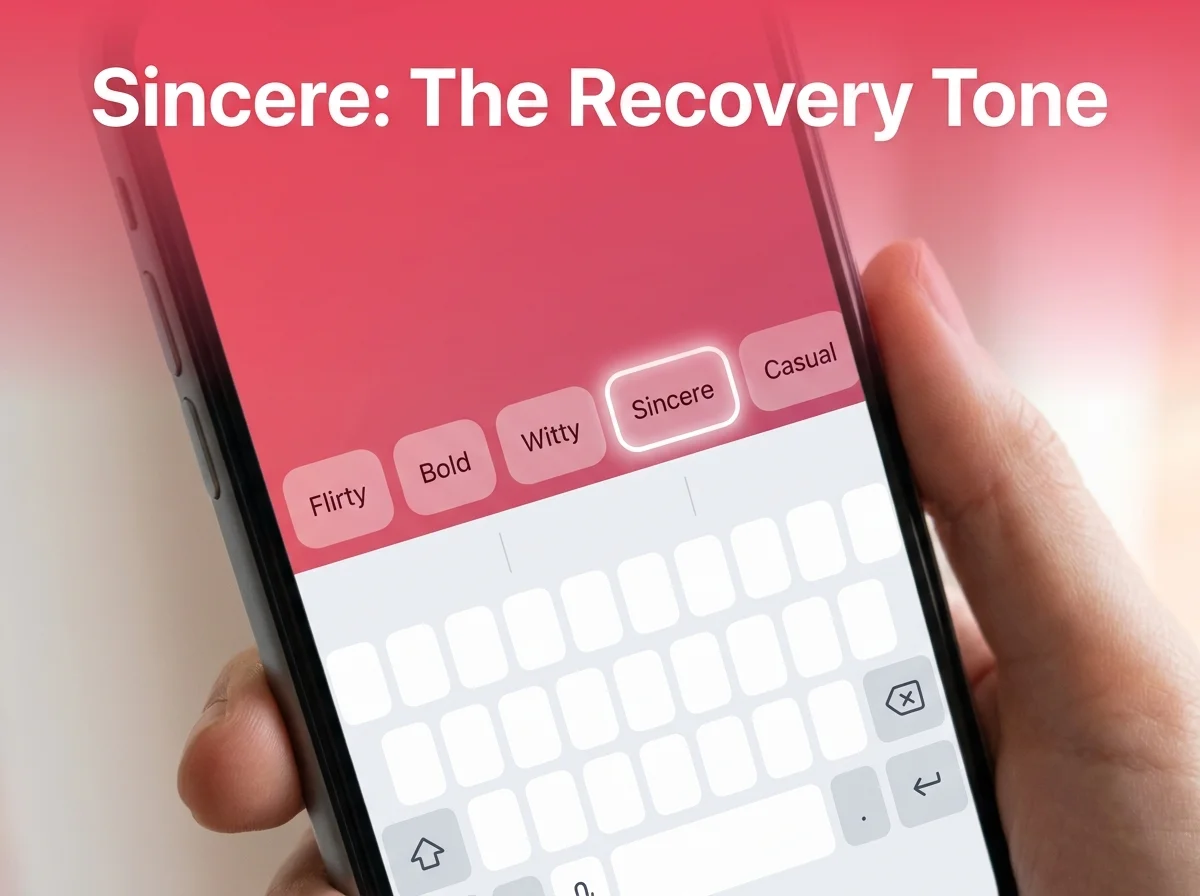 Sincere sits between Casual's low stakes and Flirty's charge — the exact register a re-engagement message needs.
The other four tones actively work against a recovery message. Flirty and Bold read as pressure right when she needs the opposite, and Witty can land as deflecting, like you're joking past the fact that she disappeared.
Casual undersells it, too — a re-engagement text needs a little more weight than "how was your day."
SLIDD reads whatever's left of the old conversation thread on your screen, pulls a real detail worth referencing, and writes the message in Sincere so you're not the one deciding, at 11 PM, whether "thought of you" sounds needy or not.
Get Started with SLIDD AI
Writing a re-engagement text that threads warmth and pride correctly, from scratch, at the exact moment you've decided to send one, is harder than it sounds. SLIDD reads the conversation and writes the Sincere-tone version for you — no drafting five variations and deleting four of them.
FAQ
She ghosted me — can you ever actually recover from that?
Sometimes, though it's not guaranteed and shouldn't be expected. A specific, well-timed re-engagement message after 2-4 weeks reopens a real percentage of conversations — but if there's no response, that's the answer, and a second attempt almost never changes it.
How many days does it take before it counts as ghosting?
Seven to ten days of total silence after a previously active conversation is the general marker. A day or two of no reply is normal life; a week-plus with nothing at all, and no context for it, is ghosting.
What is SLIDD AI, and how does it help after being ghosted?
SLIDD is an AI keyboard for iOS that reads your screen in real time and writes a reply for you, right inside Hinge, Tinder, Instagram, WhatsApp, or iMessage. Its Sincere tone is built specifically for re-engagement messages like the ones after a long silence.
Do people ever come back after ghosting someone?
Yes, sometimes — a rebound situationship ends, a busy stretch resolves, or guilt catches up. But treat any response as a bonus, not an expectation. Planning your next move around her circling back is the fastest way to stay stuck on someone who's already moved on.